September 30, 2026

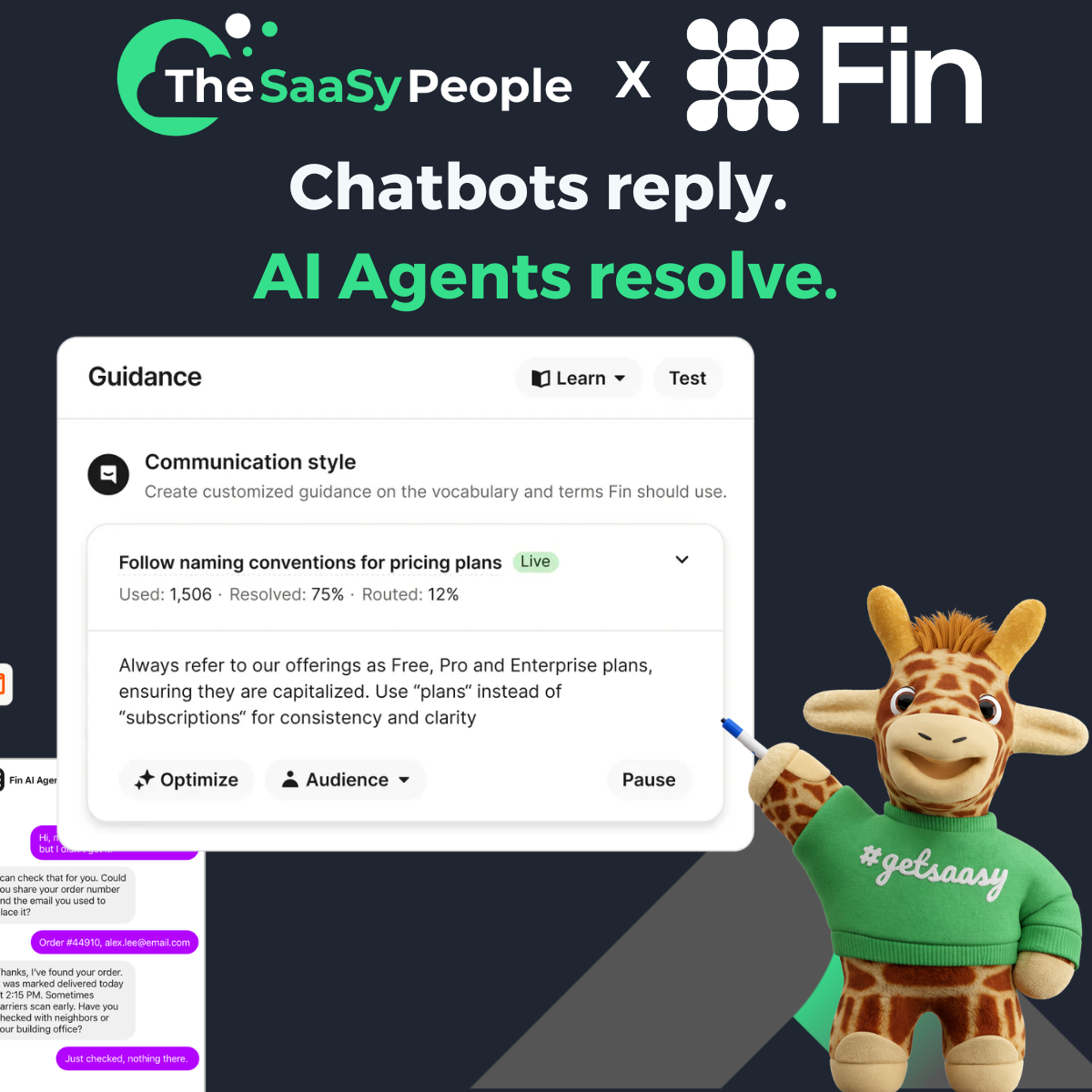
The short answer: a chatbot matches keywords or button clicks to pre-written replies inside a decision tree. An AI agent understands the question, retrieves the answer from your own content, and can take actions in connected systems to resolve the request end to end. A chatbot responds. An AI agent resolves.
That distinction is not semantics. It is the difference between a tool that deflects a handful of opening-hours queries and one that removes a significant share of your ticket volume before a human ever sees it.
Here's what actually separates them.
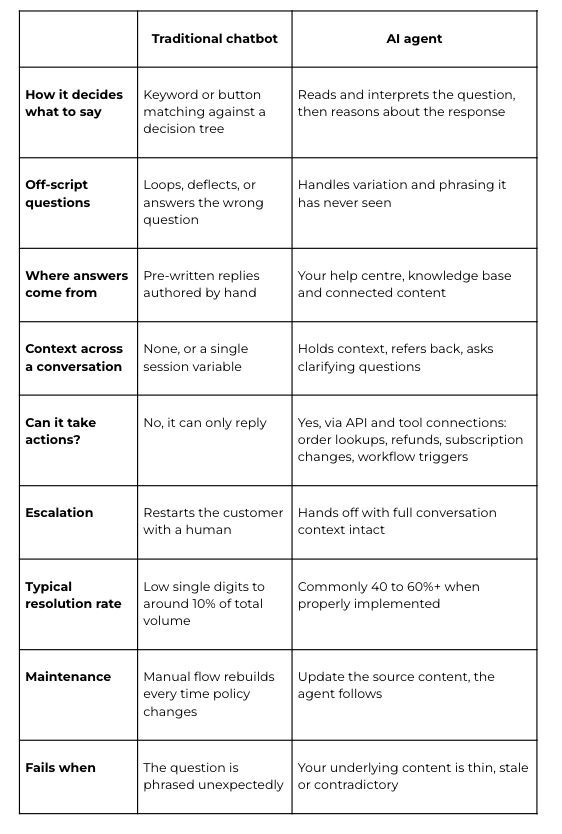
Chatbot vs AI agent: side by side
Chatbots: rules, not reasoning
A traditional chatbot follows a decision tree. It matches keywords or button clicks to pre-written responses. Ask it something slightly outside the script and it either loops, deflects to "let me connect you with an agent," or gives an answer that's technically on-topic and practically useless.
Chatbots aren't worthless. They're fine for simple, high-frequency, low-variation queries: "what are your opening hours," "where's my order." But the moment a customer's question has any nuance, the script breaks.
AI agents: understanding, not matching
An AI agent, like Fin, reads and understands the actual question, pulls from your knowledge base and help centre content, and constructs a genuine answer rather than selecting a pre-written one. It can hold context across a conversation, ask a clarifying question, and hand off to a human agent with the full context intact rather than starting the customer over from scratch.
The practical difference shows up in two numbers:
Why this matters beyond the tech
If you're evaluating an AI agent purely on "does it sound conversational," you're asking the wrong question. Both a chatbot and an AI agent can sound friendly. The question that matters is whether it can actually resolve the ticket, not just respond to it.
This is also where implementation quality does more work than the tool itself. Two companies running the same AI agent platform can see wildly different resolution rates, because one has fed it clean, current knowledge base content and the other hasn't. The agent is only as good as what it's trained on.
What good implementation looks like
The implementation gap: where The SaaSy People come in
Whether you're running Fin or evaluating whether an AI agent is worth moving away from a scripted chatbot, this is exactly what our Expert Services team implements: AI deployment work built around resolution-rate improvement and agentic workflows, not just flipping a toggle.
What good implementation actually involves
If your chatbot is quietly costing you tickets it should be resolving, book a call with our Fin Experts and we'll show you what a proper AI agent implementation actually looks like.
Frequently asked questions
Is an AI agent just a chatbot with a language model attached?
No. Adding a language model to a decision tree gives you better-sounding replies inside the same rigid flow. An AI agent has no pre-authored flow. It reasons over your content and, where connected, acts in your systems.
Do we still need human agents?
Yes. The realistic outcome is that the AI agent handles high-volume repetitive contacts and your team handles complex, sensitive and high-value conversations, with better context and shorter queues. Teams typically get redeployed rather than reduced.
How long does an AI agent implementation take?
The platform can be live in days. Reaching a resolution rate worth paying for takes longer, driven mainly by the state of your existing content and the complexity of the systems being connected. A realistic first milestone is weeks, not months, with resolution rate improving continuously after that.
What resolution rate should we expect?
It depends on volume mix and content maturity, but 40 to 60% of total volume is a reasonable target for a well-implemented deployment. Be sceptical of any figure quoted without a definition of the denominator.
Can an AI agent work alongside our existing chatbot?
Usually there is no reason to keep both. Once an AI agent handles the variation your scripted flows could not, the flows become maintenance overhead with no upside.


.png)